issue 4
// poetry
Render Error
by Pip McGough
Reality loads in layers:
first the sand
then the soldier
then the scream buffering in 4K
delayed just enough
to miss the moment the soul leaves the body.
The air smells of melted tricycles
and the breath of sun-sick prophets.
The drone overhead tells bedtime stories in American English.
“I love you,” it says,
and flattens a soup kitchen.
A little girl draws a flower.
Command calls it symbolic escalation.
So they take the shot.
Checkpoint Jesus with His Kevlar halo
asks for your papers.
He instructs you not to look up
while the sky decides if you can live.
History loops in war porn.
The desert watches everything.
Its silence:
the only honest story there is.
Report of a Centaur in Central Illinois
by Pip McGough
I remember that day well. We’d argued about history.
You said:
“History is the legible stench of incalculable extinctions.”
I said:
“History is what the survivors are permitted to say.”
We let the matter rest, though it didn’t.
Then the news: reports of a centaur in central Illinois.
The girl who saw it first was aged ten, and playing alone in a soybean field.
She had a glass eye, and no sense of metaphor.
The experts didn’t see the centaur.
They assured the viewers that centaurs were invented
thousands of years ago
to explain desire.
The police concurred,
but warned people to avoid speaking classical languages near the crops.
The anomaly was seen again in Taylorville
passing through town like a Greek participle—
untranslatable, yet necessary.
There were hoofprints, and photos of hoofprints.
Could have been a centaur, could have been a horse
(their tracks are identical).
I can’t tell you if any of this actually happened.
Reality is a cracked bell,
and this might be the sound it made.
What I can tell you however
is that I’ve encountered other myths
woven into the air like radio waves—
invisible, but quite capable of burning your ears.
So when you tell me centaurs are impossible,
I will say:
There are lots of things that shouldn’t be happening in America.
And yet they are.
Interview with Pip
Pip is one of our featured writers for Issue 4. Below are a series of questions and responses between Pip and our Interview & Feature writer, Angela Heiser.
Angela: There is a long tradition of poetry as protest. Which authors or poets have inspired your work? Is there anyone you wish to emulate?
Pip: I’ve always understood “protest” in poetry less as a matter of shouting angrily than as quietly refusing to forget. I’m drawn to those writers who hold their words accountable to the moral imagination: Mahmoud Darwish, Denise Levertov, and Muriel Rukeyser for example, who show us that beauty and witness can coexist without cancelling each other out. For the same reasons, I return to Geoffrey Hill quite often, and also to Eavan Boland and James Merrill. (I love the grace Merrill brings to the interrogation of spirit, self.) I don’t really want to emulate these writers so much as to be in conversation with them; to write as though they’re in the room, mildly approving.
Angela: What role does risk play in your writing? By that I mean, how do you feel that you as a writer take risks on the page and trust the reader to make those connections, or say the hard thing in a new and bold way?
Pip: Risk, for me as a writer, is really about clarity. It’s easy to be obscure; it’s harder to be vulnerable and precise at the same time. Every poem is a sort of wager that the reader will meet me halfway. I think I write about the places where language begins to falter: the unspeakable, the mystical, the embarrassing truth. I trust that the reader will sense this. Saying “the hard thing” isn’t about shock value; it’s about revelation, letting something unguarded come to life on the page just long enough to be recognised.
Angela: In “Reports of a Centaur in Central Illinois,” the poem’s speaker comments on unsettling forces at play in America. I am curious about the decision to set the narrative in Illinois. Could you say more about the significance of this location for you in crafting this piece?
Pip: Illinois appealed to me partly in political-geographic terms: because of the strangeness disguised as normalcy, the vast interior heartland where anything mythic looks out of place, yet still happens. Believe it or not, however, the choice of setting also grew from a real news story. In the 1960s, there were reports of a centaur sighted near Centreville, Illinois. That image appealed to me, not as folklore exactly, but as a kind of accidental magical realism.
I’d add here by way of clarification that the subject of cryptozoology (the study of unknown and otherwise mysterious animals) fascinates me, because, like poetry, it lives in the liminal space between belief and imagination, between the text and the footnote. I’ve written poems (which you can find on my Instagram account) about other cryptids like Bigfoot, the Moon-Eyed People, and the Beast of the Land Between the Lakes, subjects which let me explore what happens when the unseen suddenly becomes seen. Poetry, like cryptozoology, is a variety of fieldwork into the impossible. Both begin with the same act: noting an anomaly, and deciding it matters enough to investigate.
Angela: The line “The anomaly was seen again in Taylorville passing through town like a Greek participle—untranslatable, yet necessary” was so memorable for me and stuck with me long after reading. How did you arrive at the inclusion of Greek participle? As someone fascinated by linguistics, this is such a captivating choice of diction.
Pip: Like you, I’m very interested in linguistics. That particular line came from thinking about untranslatability as a moral state. A Greek participle is something that resists simple equivalence. It demands context, nuance, a syntax to hold it. I wanted the centaur’s appearance to carry that kind of weight, something ancient and grammatically alive, but also alien to the modern world. Using the phrase “Greek participle” was my way of signalling that the myth is trying to survive within another language, another culture’s sentence.
Angela: Then later on you have a metaphor comparing reality to a cracked bell, which resonates so deeply with all that is troubled or broken in current social and political discourse. Why did you choose a bell?
Pip: A bell indicates both sound and summons. It’s meant to call people to attention, to communion, to celebration, to mourning. A cracked bell still rings, it just rings wrong. That felt true to our moment, on both sides of the Atlantic: the idea that reality continues to speak, but no longer purely. I liked the doubleness of it too. The fracture doesn’t silence the bell, it defines its tone. That imperfection is perhaps the sound we’re all living in now.
Angela: This poem ends on an extremely powerfully worded understatement that is nonetheless an absolute tour de force. Your second poem, “Render Error,” does this as well. What advice can you give our readers for ending a piece in this way? Where did you learn it?
Pip: I think the most powerful endings happen when the poem has already done its work and the final line only tips the balance. I learned that from other poets I admire like Lucie Brock-Broido, Louise Glück, and of course Ezra Pound and his imagist tradition, the understanding that restraint can be devastating. I try to end not with a pronouncement, but with an opening, something that hangs unresolved. My advice, for what it’s worth, is to stop a poem one beat before it explains itself. Let the silence finish the thought.
Angela: The second poem, “Render Error,” is full of great work with sounds. Do you read your work aloud as you are writing it, or is this a facet of the work that comes into play later on during revision?
Pip: Yes, always. I read everything aloud, often obsessively and repeatedly. Poetry begins in the body (the mouth, the breath), and I want the reader to feel the musculature. Sometimes sound leads sense; I’ll follow a consonant the way another poet might follow an image. During a revision, I listen for friction, for places where the rhythm argues with the meaning. When that happens, I know I’m close to bringing something to life.
Angela: In this piece the synecdoche of “the sky decides if you can live” struck me so forcefully. It’s almost another incidence of understatement creating a heightened impact on the reader. You excel at this. I am also curious about the choice to write this piece as a column poem without separate stanzas, particularly because the ending from “He instructs you not to look up” could be a standalone stanza, if desired. What is the significance, for you as a poet, of the decision to write this piece as one stanza? What role does the form have in your writing and how do you believe it impacts a reader’s perception of the piece?
Pip: I think of poetic form as a kind of pressure system. A single block of text can create claustrophobia, momentum, inevitability, all of which suited Render Error. I wanted the poem to feel like a continuous transmission, almost mechanical, without a place to rest, because the subject matter itself offers no pause. The choice not to break into stanzas was intentional; each line leans on its successor, the way one bad geopolitical decision (say in the Middle East) can generate centuries’ worth of subsequent history.
Angela: What are your current writing projects and goals? Do you have anything coming up where our readers can follow or support you?
Pip: Next year, I’m honoured to have several poems included in anthologies addressing Gaza and the refugee experience. I also have an essay on the history of queer horror cinema forthcoming in Last Closet on the Left, a UK-based magazine devoted to queer film. My work likewise appears in a number of poetry journals, including Azarao Literary Journal and Paper Moths, and I continue to submit widely.
Looking ahead, I want to keep writing poems that fuse lyricism with activism, in a language that feels alive aesthetically and ethically. I’m also beginning to explore short fiction and non-fiction, expanding the forms I work in.
I’m also active on Instagram as @manifest_gothic, where I try to post at least one new piece daily. I’ve found a remarkably generous community of fellow writers and readers on Instagram. That sense of creative fellowship, of finding one’s tribe, has been invaluable. For a new writer it’s not just encouragement, it’s a lifeline.
I think it’s worth saying that I only came to the writing of poetry quite recently, in April 2025 in fact, when an illness forced me to take time away from work. I’ve long had an academic and technical interest in poetry and literature in general, but as a writer I’m still a student of the craft, with a great deal to learn and, no doubt, unlearn.
about the author // Pip McGough
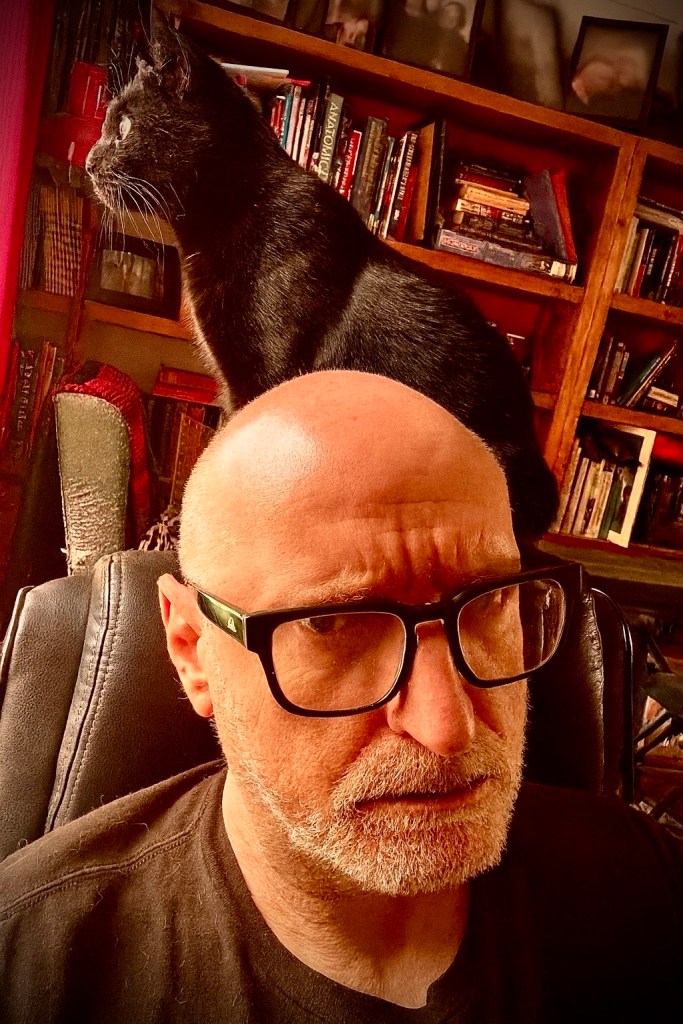
| Pip McGough is a UK-based freelance writer whose output explores the uncanny intersections of myth, memory, and the modern world. He blends lyricism and political commentary with dark humour, often drawing on folklore, religion, and metaphysics. At present, his work is necessarily preoccupied with the issue of Palestinian liberation. His writing spans poetry, children’s fiction, and surreal short forms, frequently invoking landscapes as witnesses and the body as metaphor. |
Instagram: @manifest_gothic
 wildscape. literary journal