issue 8
// fiction
Kelly is our featured writer for Issue 8. Below is her short story, and beneath that, a series of questions and responses between Kelly and our Interview & Feature writer, Angela Heiser.
Dining Hall Alchemy, or How to Transfigure a Fork and a Friendship in Seven Easy Steps
by Kelly White Arnold
1) After dinner in the university cafeteria the first week of classes, high on carbs and burgeoning best friendship, bohemian hearts bent toward the quirky, steal two forks from the dining hall. Feel no guilt—they’re so cheap they are essentially plastic with aspirations of grandeur.  Giggle with your roommate as you smuggle them back to your tapestry-filled dorm.  Burn incense and light approximately forty-five candles. Conjure amateur plans for transmutation.

2) Rest said forks on your dingy dorm room windowsill, mostly untouched while you make out with a slew of lackluster man-children and your roommate smokes bowl after bowl and weaves flower crowns from weeds.  Fall asleep to Tori Amos and her ethereal piano.  Allow the rays of the full moon and the streetlight from the dorm parking lot to bathe your metals in glows alternately serene and synthetic.

3) Get into a pointless squabble about whose turn it is to buy groceries or wash the dishes piled in the miniature sink you share, an altar erected to slovenliness.  When she refuses to give you a ride to the mall, tell her she can’t borrow your body glitter out of spite.  Use one of the forks to absentmindedly spoon cold ravioli straight from the can into your mouth.  Not willing to concede, lick it clean.

4) Scavenge some needle-nose pliers from an art major down the hall and begin the tedious turning of transformation.  Impose your will upon alloy, murmur curse words like incantations as you pinch fragile fingertips bloody and still fail to bend tines into spirals as flawless as your manic pixie dream girl roommate. Notice how her voice is starting to curdle in your ears like milk in your neglected dorm fridge. Realize two is an insufficient number for a coven that endures.

5) Wear your creation out to scam drinks at the Corner Bar, where your shoes squelch against the floor and all the bar stools are ripped.  Leave your roommate at home—she has a paper due tomorrow anyway. Envision your bracelet providing magical protection from the unworthy, but realize that the fork tines, in practice, dig into your forearm like they once pierced your cold Chef Boyardee. Brandish it pointedly as you bum a clove cigarette from an artsy looking dude with hipster glasses that aren’t cool yet.  Emphasize its handmade and felonious origins.  Let its cheap radiance hypnotize.  You ARE Calypso in Doc Martens and black eyeliner.  Enchant him, bitch. Go back to his place, but don’t spend the night.

6) Lose bracelet somewhere—the apartment of your dubious situationship, a street corner downtown during a Violent Femmes concert, a cafeteria trash can on a Thursday at breakfast—your roommate won’t care.  She’s shaved her head and announced over eggs that she’s moving to London to study abroad and commune with the sarsens at Stonehenge or something.  Your talisman’s a twisted fork again, warped beyond usefulness. Feel something inside shift, break— glamour fading to dull color of weekday ordinary.

7) Thirty years later, sift through a Gordian knot of necklaces, gasp audibly when fork bracelet scrapes skin.  Lift it from tangled pile of costume trinkets.  Realize despite youthful conjurings, you are Penelope now, caught between laundry and play dates, asleep at night in a bed you built more solid than oak, his breath steady beside you, cat asleep at your feet, familiar. The glitter has long since faded, but you have woven magic more potent.  A quiet, burnished luster.  Remember the way your roommate’s hair shone autumn auburn in the streetlight.  Wonder if time has plaited garlands of gray in her tresses as well.  Slip the bracelet around wrist wizened with knowing, gaze at the witch of a woman you became.
Interview with Kelly
Angela: Your title points tongue in cheek to self-help and the piece concludes with self-discovery and evolution. Where did you draw your inspiration for this witchy, jocular, bildungsromanesque story and its form?
Kelly: This piece started during a weekend retreat with writer and teacher and wise woman Mary Carroll-Hackett (@poetinthetrees) at The Porches in Virginia (a cozy little writerspace that I HIGHLY recommend). Mary led a session on the spiritual in writing— think alchemy, talismans, prayer, invocation, and this piece started as a writing exercise for that workshop. You know how you sometimes know as you’re drafting that you have something worth coming back to? That’s how this piece felt when it was in process: writing like an incantation, something sacred and powerful.
Angela: Step 1 hints at aspirations, being an amateur who wants to become something more. How much of yourself is in the narrator? How much of the young students whom you teach before they embark on their college pathway?
Kelly: I wanted to play with the idea of coming of age, how we all (hopefully) transform from this unsure, overly melodramatic adolescent version of ourselves into something more substantial—a skin we can wear for real. I work with young people (a lot), and once, long ago, I was a young person. I wanted to capture that vibe, delusions of grandeur, the way EVERYTHING takes on undue significance when you’re young and earnest and searching. My goal is for this piece to gently poke at that absurdity of girlhood, that belief that every experience is crucial, that every connection is lifelong, when in reality, most things fade with time and age. What posers we were!
And I guess I was kind of a witchy young adult. In my mind’s eye, the dorm room in the text is 100% mine from my freshman year, full of candles and tapestries and Mazzy Star. I went to classes barefoot and wore poet blouses. Lots of velvet and incense.
Angela: We need to have a moment for the body glitter. This stood out to me as a hallmark of my teenage era (and blue lipstick with white eyeshadow, honestly what were we thinking?). How did that throwback make its way into this piece?
Kelly: Body glitter to me is SO 1990s. We all wanted to be these sparkly, manic pixie dream girl faeries, and to me, the synthetic shimmer of body glitter just represents all of that youthful pretense. And is there anything more petty than withholding that faux-ethereal shimmer-shine because you’re cranky with your roommate? It just felt right.
Angela: You draw on myth here, with characters from the Odyssey (Calypso and Penelope) and the Gordian knot. Is this the high school English teacher revealing herself or something more? What was the impetus for these anchors?
Kelly: I’m on a mythology kick right now as a poet, a reimagining of mythic women in particular, looking at them through the lens of everyday, contemporary existence. And my husband and I kind of have a running Odyssey theme, but not one where he runs around with a bunch of nymphs and washes up battered and salty ten years later. One where being Penelope means being someone else’s home in the truest sense of the word, where Odysseus always finds his way to her. And that’s what happens as you get older, right? You lose some of the glitz (and body glitter) of a temptress like Calypso, but, if you’re lucky, you find a deeper satisfaction in being each other’s constant. When we got married, our son gave us a framed photo with a quote from The Odyssey: “There is nothing nobler or more admirable than when two people who see eye to eye keep house as man and wife, confounding their enemies and delighting their friends.” It’s kind of our marital North Star, if you will, so it’s natural that Homer’s characters make appearances in my work from time to time.
Angela: And why seven steps? What does the number seven signify?
Kelly: Why not seven? If you’re gonna write something magical and witchy, you gotta divide it into a magical number of steps. There are little nods toward “magic rules” in the whole text. The fork gets bathed in moonlight and streetlight, is imbued with bodily fluids when the unnamed you licks the ravioli from the tines. I wanted to marry the magic and the mundane here.
Angela: I’m loving how you explore liminal spaces in this work, particularly in Step 5, but elsewhere as well. This tied in well for me as a reader to the self-discovery and becoming, which struck me as another hallmark of the poetic perspective you bring to this work. Tell us more about how you pictured these in between spaces (the forks not really metal or plastic, not in love, but also not out of love) and how your poetry informs your fiction and vice versa? I have highlighted so many lines that could inform a cento and I am super curious, as a poet myself, if that is a consideration you have in mind when crafting prose work. (“plastic with aspirations of grandeur,” “dingy dorm room windowsill,” “tedious turning of transformation” and I so dearly wanted to ask about “needle-nose pliers from an art major down the hall”).
Kelly: I love liminal space—in fact, Motherhood and Other Liminal Spaces was one of the titles I kicked around in the early stages of putting together my first chapbook. I feel like college, in particular, is a liminal time. You are reinventing who you are, deciding what parts of yourself you want to change, figuring out who you’d like to become.
For me, genre isn’t an initial concern as a writer. (I guess my notebook is the ultimate liminal space.) What’s important is to get the words down, the ideas and phrases. In early drafts, I thought this might be a prose-poem, but that shape didn’t end up able to sustain what I wanted to do with the piece. It became a sort of hermit-crab structure instead; the words draped themselves on the form of the list/how-to guide. So it’s not surprising that poetry has wormed its way into this text. I think working primarily as a poet informs everything I write.
The art major down the hall doesn’t actually exist, but I wanted to tap into that free-for-all, swap meet aura that is unique to college dorm living. Need something? Poke your head out into the hall and holler. The bracelet, however, is real and still lives in my jewelry box.
Angela: You probably saw this coming that I’d ask seven questions on your Seven Easy Steps piece, but here we go. Where can our readers follow and support your work? What does the rest of 2026 and 2027 have in store for you, creatively?
Kelly: You can find me sporadically online @KArnoldTeaches and at kellywhitearnold.wordpress.com.
This has been a big creative year for me. In August, Finishing Line Press published my first poetry chapbook, Decidedly Uncertain, and my second chapbook, The Automated Archive of Lost Mothers is due out from Kelsay Press in the first half of 2027.
Mostly, I’m over here trying to juggle parenting, a demanding career, my writing, an omnipresent need for a nap, and all the other components that we are all constantly negotiating. Dailiness is its own kind of magic.
about the author // Kelly White Arnold
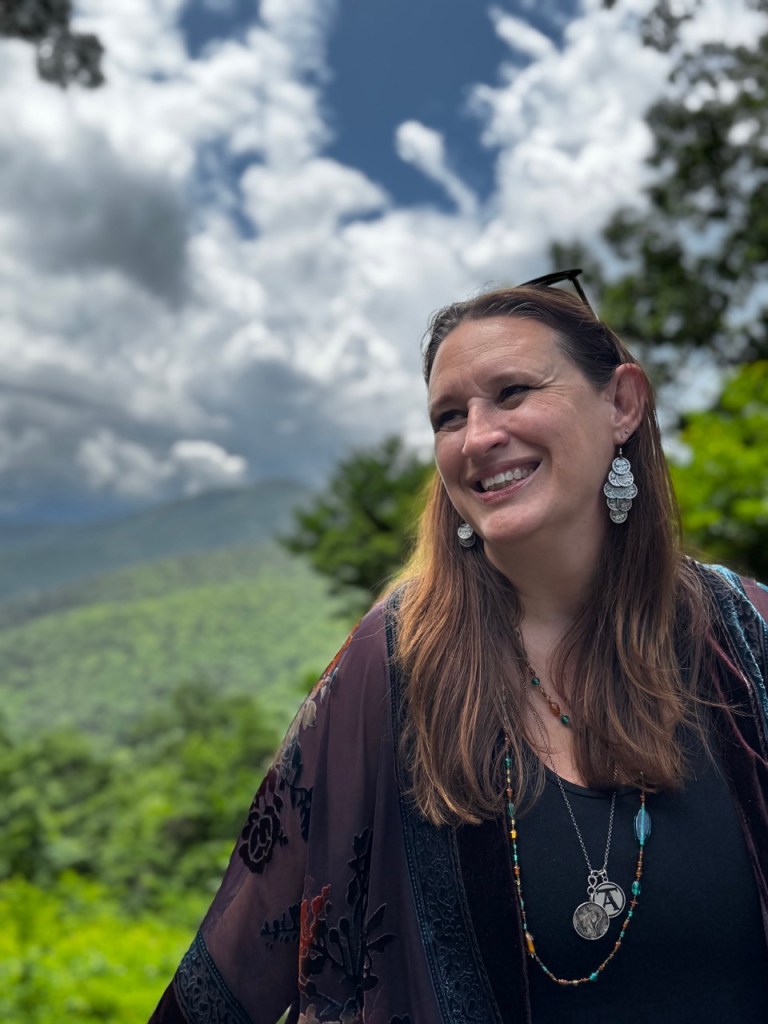
| Kelly White Arnold (she/her) is a mom, writer, teacher, and lover of yoga. Her work has recently appeared in Anti-Heroin Chic, As the Crow Flies, and Reedy Branch Review. She lives in the North Carolina Piedmont with her two favorite humans and one unhinged cat but dreams of mountains beneath her feet. Her first chapbook, Decidedly Uncertain, is available from Finishing Line Press. Online sporadically @KArnoldTeaches. |

