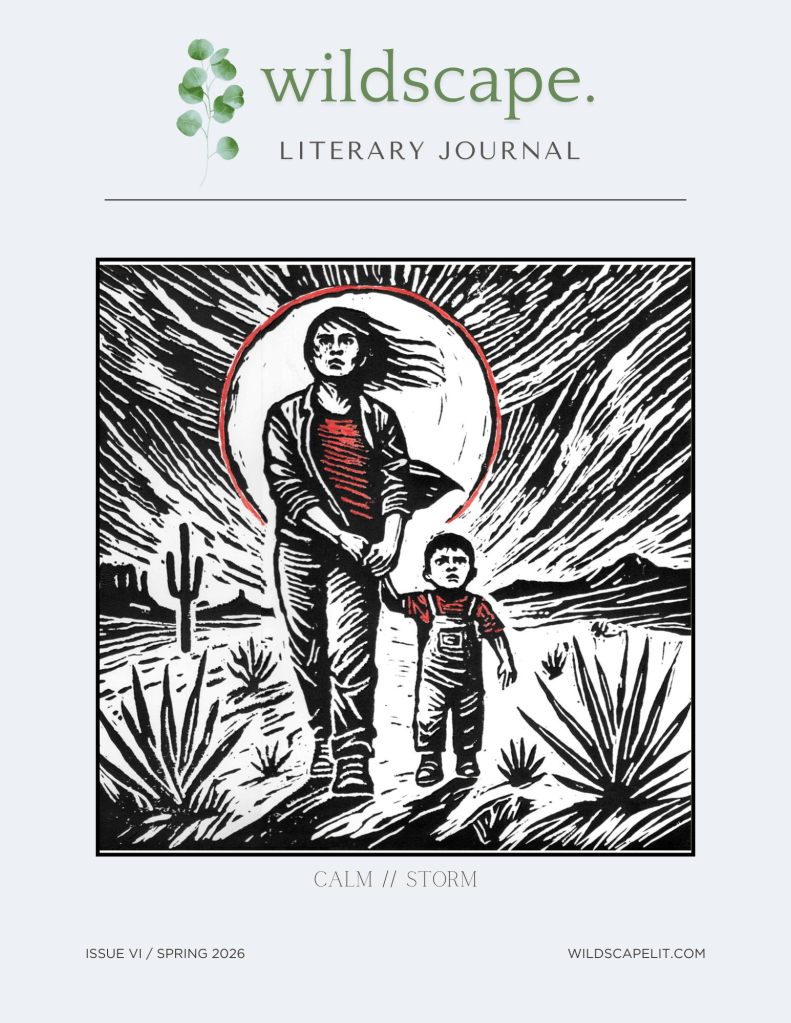
issue 6
// fiction
Chloe is our featured writer of Issue 6. Below is the link to her flash fiction piece in this issue, and beneath that, a series of questions and responses between Chloe and our Interview & Feature writer, Angela Heiser.
Read Chloe’s flash fiction piece, Spaces of Waiting.
Interview with Chloe
Angela: Wordplay with space as room to grieve and outer space is genius. How did you choose which elements and features of space to include?
Chloe: Grief manifests in so many ways. To me, it feels vast. Almost liminal. I chose dark, endless space to represent it. The specific space elements aim to serve this immensity as well: “Immeasureable galaxies and incalculable gas giants,” “billions of stars” and “thieving black holes.” I wanted the characters and reader to experience both a symbolic and literal ‘rock bottom’ feeling from the magnitude overhead.
However, in something so unexplored and empty, perhaps there’s also room for hope to fit. But like a shooting star, you need to look up to see it.
Angela: Gorgeous imagery is front and centre here and certainly a strong suit of yours. What is your approach to inserting such evocative and precise images in your work? Where do you find the right balance?
Chloe: I feel wayward without a strong sense of place, so most of my stories have imagery or sensory detail. I especially like imagery with movement. Static imagery is slightly more difficult to picture, but movement makes the story feel alive, breathing. My approach is to weave in as much imagery and setting as possible while still maintaining the flow of the story. Especially in a story like this, where the setting and emotional states are overwhelming, those small, unique details, such as a cluster of freckles, can help keep the reader grounded.
Angela: As a poet I am always looking for poems and poetic language in the writing of others and I find so much here. What influence does poetry or figurative language have on your work?
Chloe: To be honest, I don’t read much conventional poetry, and I really should read more. Whenever I do read poetry, I’m always blown away, but I’m just deeply attached to narrative prose. I envy the dedication of poets. Their control over cadence and language is truly something else.
What has a strong influence on my work is upmarket and literary fiction. Poetry and figurative language get woven into those words, and we ultimately end up with that decadent, delicious writing. That’s the kind of prose I strive for: a lyrical richness you can feel swilling around your mouth.
Angela: As a parent and bibliophile, I have to ask about the significance of the two children’s book titles you included. The first is The Very Hungry Caterpillar and the second, which I had to look up is Possum Magic. Tell me about magical possums and why they make the cut in this flash piece?
Chloe: Possum Magic is a book I grew up with and vividly remember. It has this magical Australian whimsy that feels so nostalgic to me. If you bring up children’s books, that’s the book I think of.
It was written in 1983 by Mem Fox and illustrated by Julie Vivas. Essentially, Grandma Poss uses her best Australian bush magic to make her granddaughter, Hush, invisible. It makes her safe from the hurt and dangers of the world, but eventually Hush grieves the sight of herself, and they must find a way to make her visible again.
This is also not the first time I’ve referenced Possum Magic in a story about grief and longing. I mention this book in my Pushcart Prize-nominated flash fiction titled The Grief which is published in the 2025 Not Quite Write Prize for Flash Fiction Anthology.
Now reflecting on it, that could be another reason why I referenced Possum Magic. Grief gets swept under the rug so often; it’s a taboo to talk about pain. People who are hurt become invisible. Perhaps there’s something symbolic there, too.
Angela: What is it about the atmosphere surrounding a used bookstore that offers such safety-both in your narrative and in life?
Chloe: With the state of the world right now—education cuts, book banning, dwindling literacy rates—a used bookstore acts as a bastion of the arts. Their books can’t be edited or censored. It is defiant persistence fortified by brick and mortar.
It’s somewhere people can anchor themselves. A kind of comfort. Whether it’s these characters building a routine around visiting the used bookstore, or a young Australian girl reading about magical possums, there’s power in books that should be respected.
Angela: What helped you end on a note of optimism in this vividly poignant piece?
Chloe: This is a very soft note of optimism, and I’d probably call it blind, desperate hope. I didn’t want this story to end on an overly cheery note, because I won’t make mockeries of deeply serious topics. Instead, I stuck with the idea of “this is what’s happening now”. Pain is being felt loud and publicly, in the moment, rather than watered down to be palatable.
I find the nature of grief is really important to talk and write about. If we don’t talk about these experiences and emotions, it gets swept under the rug. Then, people grieve alone. They believe their experiences are singular. These devastating issues become taboo, making others squirm when it gets brought up. However, awareness brings about legislation, funding, and accommodations. Shared experiences make for shared change.
Angela: Tell me about souls. Souls and stars have almost equal weight in “Spaces of Waiting”. What do you believe about souls and how does it differ from the speaker in your work?
Chloe: With all art, we tend to bleed on things and write what we know, but I try not to centre myself in my stories. A writer’s presence shouldn’t be heavily felt in a story; it’s about immersing the reader, keeping them there, and hoping they come out changed. That they’ve felt something.
So, what I will tell you is that I went down a deep research rabbit hole for this story, and learned so much. Ethnoastronomy is the study of a culture’s beliefs and practices surrounding celestial bodies. Aboriginal Australians were the first astronomers, long before many other early civilisations, and it’s devastating how much rich culture has been lost due to invasions and time. Ultimately, other cultures’ stories aren’t mine to tell, so I encourage people to seek out those stories themselves and listen closely.
Angela: Your ending struck me as pure poetry and almost like an Easter egg for the reader, but also bringing us back to the title. I am so curious how you managed to align these elements. When you began writing this piece, did you envision it this way or was it an evolution over time?
Chloe: I envisioned it this way. As with all my stories, I begin my process at the end. I write the ending first, then reverse-engineer it, figuring out the best plot to make that ending land. I then flesh out the opening and go from there. I discover the title somewhere in-between, once the emotional crux shows itself. Coming back to the idea of hope within the vast space of grief, the final line reads likes it’s falling out of the sky. A shooting star of words.
Angela: Tell me about the interrelatedness of arts and science in this piece and how you see it fitting into their interrelatedness in the broader world.
Chloe: I’m no expert in this, and I don’t parade as one. But specifically in this piece, the two work together to achieve one emotional effect. You can look at grief through either lens and it’s still grief.
Both art and science start with the willingness to understand the world around us, and I like to think they have a symbiotic relationship, that one leads into another. Less of a dichotomy, more of an ouroboros.
Angela: What does 2026 hold for you and where can our readers support your work?
Chloe: I planned for my 2026 to be quiet on the writing front, prioritising rest over progress. That didn’t happen. In the first week of the year, I won two large flash fiction competitions, then a third in April. I’ve had so many stories falling out of me that I haven’t wanted to slow down anyway. Even as I write this, I’m booking flights to Sydney to attend the launch party for another anthology I’m published in. It’s an unexpected joy, this year so far.
I’m unsure how the rest of the year will go, but I’ll ride the wave of whatever is brought to me. I hope it’s all good. I hope I have more stories in me. I hope I take more creative risks, do more of what scares me, and meet more lovely people like you. Maybe I’ll find the time to take a nap, too.
I’m on Instagram (@chloepaigeauthor) and Bluesky (@chloepaige.bsky.social). Thank you so much for publishing my work, for showing interest in what I have to say, and for publishing this issue to showcase a spectrum of experiences we might not find anywhere else.
about the author // Chloe Paige
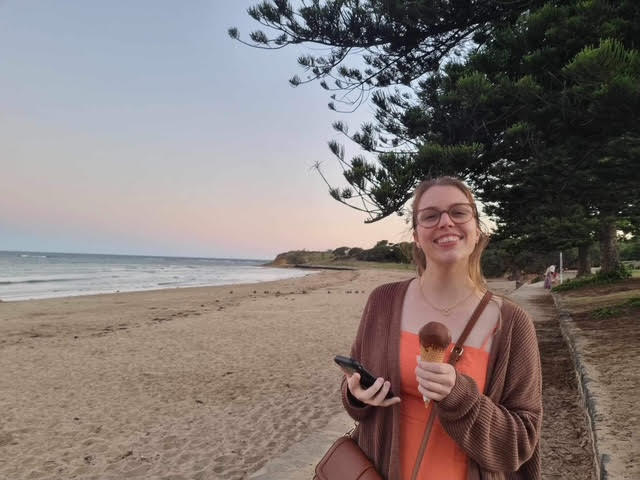
| Chloe Paige is a Pushcart Prize-nominated writer from the salty shores of Wadawurrung Country in Geelong, Australia. She is published in a small handful of online and print literary journals, and has won the Elegant Literature Award, NYC Midnight, The Booby Prize, and has shortlisted multiple times for the Not Quite Write Prize for Flash Fiction. She adores strong verbs, flouting the writing rules, and rambling about literary devices to people who truly couldn’t care less. |
Instagram: @chloepaigeauthor
Bluesky: @chloepaige.bsky.social
 wildscape. literary journal