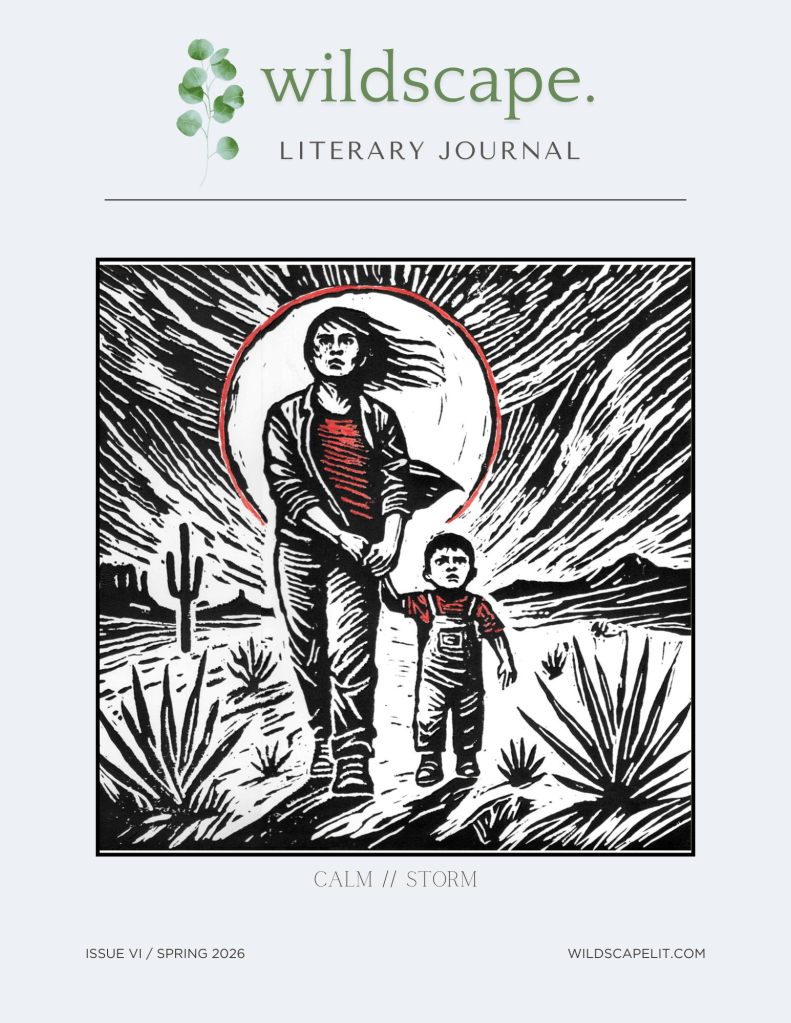
issue 6
// poetry
How To Write Allegory
by Faith Otieno
First, pick a country that does not exist.
Call it a garden.
Gardens are neutral. Gardens make people lower their guard.

In this garden, the soil is very rich.
So rich it stains the hands of anyone
who claims they never touched it.

There is a river.
There is always a river.
It once fed everyone.
Now it carries bodies
and press releases downstream.

Do not call them bodies.
Call them leaves.
Allegory loves leaves.

Next, introduce the caretakers.
They have uniforms.
They say they are maintaining order.
They say the fence is for protection,
not exclusion.

They say the gate only closes
on people who don’t belong—
which is impressive,
considering the gate decides that part.

Somewhere in the garden,
children are very good at hiding.
They have learned which sounds mean danger,
which silences mean worse.

Do not describe the children too clearly.
Readers prefer innocence
when it is abstract.

Now add a ruler.
Old.
Comfortable.
Has been there so long
the throne thinks it’s furniture.

The ruler speaks of stability
the way arsonists speak of warmth.
The ruler insists the fire is necessary.
The ruler has many friends
who call this leadership.

There will be rebels.
There are always rebels.
Make them vague.
Vagueness keeps the poem publishable.

Say the violence is complicated.
Say both sides are hurting.
Say history is long
and therefore no one is responsible.

This is a key step.

In the distance, powerful neighbors watch.
They shake their heads.
They issue statements.
They sell weapons with clean invoices.

They say they are very concerned.
They say they are monitoring the situation.
They do not enter the garden.
They own too many of them already.

If anyone asks why the garden keeps burning,
say it is ancient.
Say it is cultural.
Say it is unfortunate.

Do not say it is designed.

Finally, end with hope.
Allegory must always end with hope.
A seed.
A sunrise.
A child looking toward the horizon.

The reader should feel inspired
and absolved.

Close the book.
Turn off the news.
Congratulate yourself
for understanding the metaphor
without having to change anything.

That’s how you write allegory.

Clean.
Elegant.
Bloodless.

And if anyone recognizes the garden,
deny it.

Say it could be anywhere.
about the author // Faith Otieno

| Faith Otieno (she/her) is a writer based in Nairobi, Kenya. Her works explore memory, faith, love, heartbreak, healing, the body, and becoming. When she’s not writing poetry, she enjoys cooking and bingeing the same comedy shows she has watched five times already. She is also pursuing her Master’s degree in Diplomacy, Development, and International Security and is interested in the intersection of politics, identity, and personal narrative. |
Instagram: @words.by.faith

