issue 5
// fiction
Karen is one of our featured writers for Issue 5. Below is her short story, and beneath that, a series of questions and responses between Karen and our Interview & Feature writer, Angela Heiser.
Feral
by Karen Zlotnick
She stands across the paddock, nostrils pulsing, hooves planted.

I try not to think of her as menacing.

Inside the gates of the sanctuary, under the arm of July’s midday sun, mucking manure among the herd feels right. I swat flies like the horses do.

Someone tied this mare to the entrance gate. No note. No plea. She reared and threatened to kick but was too exhausted to connect.

On her intake form, they wrote “Feral.”

                                                                               ***

A court called me a precocious runaway, but my aunt, who knew what happened under my father’s roof, got a lawyer to label me emancipated, rented me a studio, and shared an ad for barn help. A graying man whose name I can’t pronounce taught me my job. I call him Uncle.

I started when I turned sixteen, last year. I muck, throw hay, fill troughs, feed mash to the skinniest, detangle manes, dislodge rocks from hooves, pluck swollen ticks, cold-hose distended tendons. Uncle cautioned, above all I must earn trust. Learn to be still when their eyes pucker with worry. He said, What you give, you’ll get.

                                                                               ***

They’ve given her a name, but I call her Feral.

Her ears are pinned non-stop, keeping her paddockmates at bay. 24/7, she guards an invisible circle around her.

Feral is a dark bay, her black mane matted into ropes. It’ll probably stay that way for months.

                                                                               ***

I’m not a trainer, but I know the basics. Encourage a behavior, and if she delivers, even accidentally, offer a treat.

One afternoon, I’m asking her for permission to approach. I won’t go too close; I can toss a pellet from six or seven feet away. Uncle calls this teaching her to withstand pressure. The pressure is my presence in her space. The goal, to build confidence and trust.

I take a step; she turns away. I retreat, one step back.

A dance.

I’m not being dramatic when I say Feral’s life hangs on this. If she can’t learn to accept care, she’ll be deemed dangerous. I don’t know where the dangerous horses go.

Removing pressure works. Feral stands still. I straighten my back to give the impression of calm, but neither of us is calm.

                                                                               ***

I try to imagine the rescues when they were babies, before terrible things landed them in sanctuary. Who was Feral as an innocent? Unknowing. Unprepared. I believe her eyes were soft, her lips loose with wonder.

Thinking this way helps me give her grace. I can do this for horses, but not for humans. I’ve seen old photographs, but I can’t imagine my father was ever innocent.

                                                                               ***

I place my foot in front of me; she leans but doesn’t turn away. I toss her a treat. It’s a lousy toss, too far in front, but she stretches and finds it in the dust. Slowly, I let air leak out of my chest  and bring my other foot forward. A miracle, Feral stands still. This time, the treat lands at her feet.

The air between us is both heavy and feather-light, bristling and hushed. I laugh when Bart the donkey brays and tromps over to join us.

                                                                              ***

A new hire arrives–lanky, clean-shaven, mossy-eyed. I remember from ninth grade biology, only 2% of the population have green eyes. My father is the only other one I know. I recoil at the thought.

James is too slick, but they trust him with the farm equipment, and he invites me to ride in the Kubota for evening check. I work alone, but my muscles ache so I agree. Dusk has shifted the light.

James is all chatter—Denver got dewormed; the Haflinger is pregnant. I notice that his voice is reckless, discomfiting. Between fields, his hand grazes my thigh. Knowing now is a time to advocate for myself like the judge said, I say, Never.

What? he asks.

His mouth curls into a smirk, assuring me I’m not crazy. I scoot to the outside of my seat.

                                                                                 ***

The last paddock we check is Feral’s. I hop out of the Kubota.

James taunts me when I bend down to look at an abrasion on Bart’s leg. Nice ass. Then, What? I’m talking about the donkey.

My heartbeat accelerates. I’m determined to hide my fear.

Feral appears behind me. One hoof paws at the dirt, which I’ve never seen her do. What are you trying to say? I ask.

James sucks in air, points to her, and yells, Yo, that mare is evil. She kicked me the other day! He lifts his pant leg to reveal a curved bruise. I gave it right—

The noise Feral makes is guttural. She tosses her head in a frenzy, and her roped mane beats against her neck.

She is untethered, free to act on her impulses. How strange, how treacherous to live in this world without obligation.

I face her. My voice is soft, but she’s fixed on James who’s firing words at her. Stupid. Feral. Undeserving.

I know what it’s like, to be diminished this way.

Feral inhales. Ears back, head low, she charges. James uses his arms to shield his pretty eyes while he cowers, all six feet of him pinned under dust, thick as I’ve ever seen. Until it clears, I can’t see that Feral has stopped just short of knocking him to heaven.

                                                                                  ***

Uncle appears, grabs James’s arm, and points him towards the exit. Relieved for now, I acknowledge I have more to learn about advocating.

I consider what it means to find sanctuary, what it takes to provide it. I think of my aunt, who never asked for the unspeakable details, who found me, gave me time, didn’t insist on anything, not even my own healing. Then I survey the field. On the hill, separate from the herd, Feral has planted her hooves on the cooling ground.
Interview with Karen
Angela: A central theme in “Feral” is labelling. I loved how your speaker embraced and owned feral as a positive connotation. What does it mean to you to be feral and/or labelled by others?
Karen: I love that you picked up on the idea of feral as potentially positive. I volunteer at an equine rescue, and sometimes the horses who have suffered deeply take a really long time to connect with their caretakers. I like to believe they’re in touch with something deep inside them when they’re insisting on their own timeline. I actually find it admirable.
As I considered what it means to be feral for this story, I thought about how for a human, it can mean having an awareness of what one needs to survive. However, it’s complicated. The feral state can make a human dangerous. A feral horse simply doesn’t want to be handled and is only dangerous if the need for hands-on care arises. A completely feral human, however, might not be connected to others’ needs or feelings, social norms, or even laws. I find that scary. James, the character, is feral in a way that’s very scary to me.
The connection to labelling is so interesting. Every time I’m at the rescue, I learn something about that–from the expert staff and from the rescues themselves. Time, respect, distance (if needed), and consistent care are crucial elements in gaining trust. And during that process, it’s important to avoid labels. For example, I’m thinking of one horse who arrived at the rescue exhibiting bullying behaviors, pushing around other horses, and humans, too. But with time, he became a steady, respectful member of a herd who is also gentle and affectionate with everyone who cares for him. If anyone had labeled him “a bully” when he first arrived, that might have been damaging for him in the long run. Instead, his caretakers accepted that he just needed time to reveal who he really is. It feels like an approach that might work for humans, too.
Angela: The speaker demonstrates resilience in the aftermath of hardship and trauma. Her ability to stand up to a would-be abuser (James) is particularly laudable. I am curious to know more about your inspiration for this piece and crafting it, particularly the female main character this way.
Karen: There’s a mini mare at the rescue who is determined to hang onto her feral state. She arrived a few years ago, and she still does everything she can to avoid interacting with humans. I’ve spent a lot of time in her paddock, wondering about her trauma, reminding myself that she’s on her own timeline and that she might be choosing a life that doesn’t include human affection.
For the story, I started to think about humans who need time and space to heal. The narrator came out of my desire to say something about resilient young women who’ve been victimized and need the kind of support the narrator’s aunt gives her. The aunt is so intuitive–in not asking for the details of the narrator’s experience and not insisting on her healing. Sometimes it’s just about providing space and opportunity.
James appears in the narrator’s life just as she’s learning to stand up for herself. It’s a terrifying encounter for her, and she manages, but she’s shaken. Then Feral, the mare, models another kind of boundary-setting with James. It’s primal, instinctual, and very effective. I like to think that the mare’s behavior exemplifies what a definitive “no” might look like.
Angela: The narrator and Feral both need to heal, “find sanctuary” as she puts it. I love that her aunt provides her this, holding space for her without pressure. To me as a reader, this aunt played a much larger role than what we are shown in this flash piece. What can you tell us about your decision to portray the loving aunt the way you did?
Karen: Oh, I’m so glad you asked me about this.
In a small way, this story is a tribute to aunts. Growing up, I had two aunts whom I adored. They were so different from each other, but they were both so generous and loving. I was an anxious kid, and I sometimes imagined what would happen to my siblings and me if our parents died. But I always landed on the fact that our aunts loved us as if we were their own.
I also want to say that my children have three aunts who are as generous and loving as mine were.
Angela: The narrator shows us Feral as free and untethered at the end in the altercation with James. This piece as a whole mirrors that sentiment and I wonder what those things mean to you in your life and writing. What does it look and feel like to be free and untethered and afford the same to others?
Karen: I love the way you worded this question, particularly the last part about what it means to “be free and untethered and afford the same to others.”
In the story, James is untethered, but I don’t want to afford that to anyone–the propensity to live by his urges without consideration for anyone else. But when we’re talking about the idea of personal freedom with social responsibility, I’m all in.
In my own life, I consider myself to be comfortably tethered. My richest experiences are rooted in my connections. I was an English teacher for thirty-five years, and I was happily tethered to my work. I have a super tight family and friendships that are almost as old as I am. I’ve never had much of a desire to be free of those connections and the responsibilities attached to them, but it certainly was compelling for me to play with that freedom as a theme in “Feral.”
I admire people who are self-aware enough to know that a family-centric life isn’t for them, particularly women who feel pressure to get married and have children. Women who, in the face of that pressure, find ways to articulate and chase their own dreams. The narrator in this piece is at a point in her life–on the cusp of adulthood–when she’ll have to think about that and forge a path that honors who she is, once she figures that out. I don’t believe she’ll ever be totally feral, but she might swear off deep relationships for a while. What I want for her–and for anyone who’s been traumatized–is sanctuary, which I’ve come to understand is not just a place with nice grass. It’s time and space and the absence of unreasonable expectations.
Angela: Where can we follow you online and support your work?
Karen: Thank you for asking!
I’m on Instagram (kzlotnick5), mostly as a consumer.
My stories have appeared in the following literary publications: The Avalon Review, The Literary Nest, Sweet Tree Review, The Bookends Review, Barren Magazine, Pithead Chapel, Typishly, Stonecoast Review, jmww, Moon City Review, Five on the Fifth, Third Wednesday, Persimmon Tree, Litbreak, Gooseberry Pie, Macrame Literary Journal, and The Jewish Fiction Journal.
Angela: What are your writing goals for 2026?
Karen: I’m usually not a goal-setter, but I do want to find ways to have more fun with revision. I’ve abandoned too many stories because I’m either too overwhelmed or too lazy to address the issues that need attention. Thoughts and prayers are welcome.
Thank you, wildscape.!
about the author // Karen Zlotnick
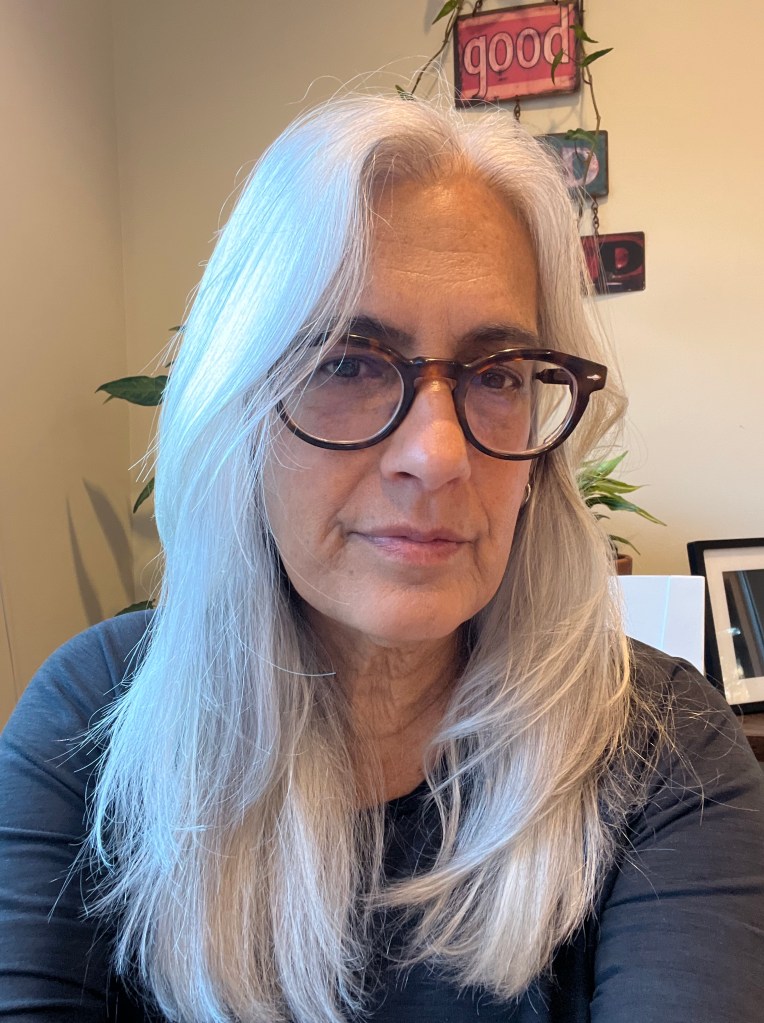
| Born and raised in New York, Karen Zlotnick (she/her) lives in the Hudson Valley with her husband and their Newfoundland dog. Some of her work has been featured in Pithead Chapel, Typishly, jmww, Stonecoast Review, and Moon City Review. In addition, one of her stories was nominated for Best Small Fictions. |
Instagram: @kzlotnick5
 wildscape. literary journal