
i s s u e: 2
// p o e t r y
Issue II’s Featured Poet: Fizza Fatima
Read the interview with Fizza here.
Cityscape
by Fizza Fatima
buildings borne
out of the ribs
of other buildings
grow new limbs
to house ever-evolving
organs
and we carve new
airways
            construct valves
            control traffic flow
build atriums for trains
in hopes that
            if we get enough oxygen
            into all ventricles
the ballooning lungs
of our metropolis
will live to breathe another day.
the city is always
out of breath
always contracting
and expanding
in labor pains
what becomes of a body
fighting to live between
pains
what becomes of us
trapped on the interstate
stuck inside a held breath
the image of me
framed in the city’s
Wince
Perhaps it is in the
nature of my chronically ill
person to diagnose
the surrounding infrastructure
with pain
but on long
commutes
I swear I can hear the memorial bridge groan.
what kind of day has it been, (what kind of poem is it)?
by Fizza Fatima
In due time
A silence falls
My window is left full of
dried out chitin shells the
color of corn husks. Aged,
papery wings sit pressed
between the glass and the
jali. Like flowers pressed
between pages of books.
Their stories frozen in
                              rising action.
I.
The graveyard in my bathroom
window exists between the jali
and the glass. I cannot think of
the English word for jali. But this
is not a language poem. I simply
cannot think of the word for that
meshing of net that sits inside
windows—between glass—
sometimes before it.
It is guarded by
three eight-legged
reapers that build
their clotheslines to hang corpses out to dry on.
They are the
world’s oldest
weaving spinsters.
They guard.
Like their ancestors
before them.
Watching over the caves
of a much older
God. But this is not a religion poem.
One is brown,
kind of fat and stodgy.
One is gray,
small and silky.
One is large and skinny,
all legs—brown
as well.
There are three spiders
in my window.
Three.
The number of fairytales.
But this is not a story poem.
Although, the window
has been known to frame
many a narrative
caught in a purgatory in-between
Filled with
frantic wing-beats
thrashing against glass
and net
and webbing.
buzzing anxiety
persistent in its journey
chasing the new sun.
An ocean away
 a thousand windows shatter
and three girls left standing
frozen
   like pressed flowers
witness
                      their father shot
dead
in the street below
framed   in    broken      glass

What kind
of a poem is
this?
بارش (baarish)
by Fizza Fatima
sounds like the rush of
rainwater
dripping in torrents

carries with it the
long vowel of the ا (alif)
an homage to the
long distance the rain travels
before hitting the earth with a
rishhhhhhh (رش)
a clattering of I’jaam
as though the dots on the ش (sheen)
are emblematic of the beaded
raindrops crashing
against the ground

the curve of the ر (re)
an upturned umbrella or
the earth’s bend
rising
to meet the raining heavens

This. Is how I come to
understand my mother tongue.
In the shape of letters as foreign
to me as ancient hieroglyphics,

in the twang of accents mimicking
the sounds of lived experience,

 I trace the stories of my ancestors

try to understand the singing of
songbirds in monsoon season
in the sounds of a language born
from my mother
making it much more
a sister-tongue than anything else

a language I can’t help but search for
in the sounds of rain
falling in a land
thousands and thousands
of miles away from my mother’s
because surely
the rishhhhhhhhhh of water pouring
from the heavens makes
the same sound
no matter where it hits the earth
surely rain cannot be lost
in translation
about the author // Fizza Fatima
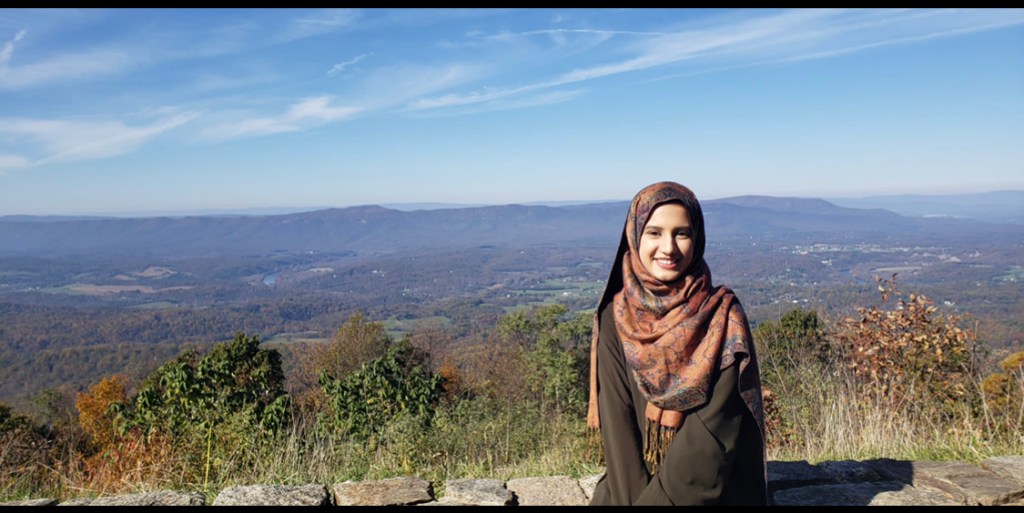
| Fizza Fatima is a writer wrestling with the worries of writing from within the Heart of Empire. It’s not lost on her that while she frets over metaphors and similes, argues with herself about the correct placement of enjambments, Israel is setting fire to refugee encampments. Fizza would like to take this space to condemn the Genocide in Gaza and highlight the story of a young writer named Nour who at 16 years old writes with more resilience, courage, and heart than all the writers of Empire. Nour hopes to publish her own books, and mourns the loss of her collection at home. She speaks of the walls of her old room bearing witness to the destruction of her home, the same walls which witnessed her grow up. Here is the link to her chuffed campaign. Please donate whatever amount you can. |
Substack: FizzyMusings
 wildscape. literary journal