
i s s u e: 2
// p o e t r y
Sweet Rememberings
by Olu Ayo
Many times a year, my mind returns to the Mango tree,
the squat figure with roots that bulged the earth.
It’s the Nigerian sun I remember most,
the way it honeyed the leaves.
No, that’s not true.
I remember you most, as we sat in our Mango tree.
Our pure imaginings, undiluted by any racial reality, what was racism to us?
For a short time longer we were the default,
the main audience,
the primary demographic.
Our pure imaginings were of an America worlds away.
In our, as of yet, unstrained minds, we modeled and maintained American streets of gold,
brilliant in the ever-shining sun.
Actual streets of gold, we were too new to the world to have grasped metaphors or hyperboles.
Too nascent, to distrust hope and optimism.
Everything was literal.
Now I know, I know too much.
In our limited way, we were saying goodbye to these red-dirt lands that shaped us and our ancestors,
to the red clay soil that nurtured us.
Maybe we knew we would carry the dusky red of Ife in our veins, the oily crimson of obe ata on our tongues.
Maybe the grit of this place would stay in our bones, work its way into our marrow, and home could be nearer.
I remember it was days later, after that last time balancing on the bark of our mango tree, that I was away in a red-eye plane.
And I awoke in America,
a stranger,
a curiosity,
an amusement.
Could we have known, those two days before I left my birthplace for all and good, the true spirit of loneliness, its dark, liquid center?
Was there even a hint of knowledge in our jokes, in our attempts to get the other to snort up a bit of mango flesh?
Could we have known in ‘95, before Eric Gardner,
before Walter Scott,
Freddie Gray,
Philando Castile,
Botham Jean,
George Floyd,
Robert Forbes,
Barry Perkins,
Trayvon Martin,
Breonna Taylor,
that this was the most human we would ever be in the eyes of any society?
Could we have known then, at age six and seven, that our lives would go on to matter in varying degrees, conditionally,
conditional to the economy,
to misinformation,
to employment,
to the preservation of power,
to pleasure,
to entertainment,
to music,
to fashion,
to income,
to housing?
Could we have known then that the mango tree with its sucrose flesh, its juice like liquid sun down smiling lips, its fibers catching in our teeth, would grow for decades beneath our collarbones reaching up and out for home, a home we may not recognize anymore?
Is our mango tree still there,
down the street from Obafemi Awolowo University, past the cement walls?
Does our tree remember us? Because I barely do.
At thirty-five, I see us in flashes,
a swiveling smile,
a yellowish orange mango tossed in the air,
us, squeezing each mango reflexively to check for ripeness,
our over-ambitious bites,
our laughter,
crackling,
high,
not yet buried by puberty.
Then, that sweet, sweet remembering.
about the author // Olu Ayo
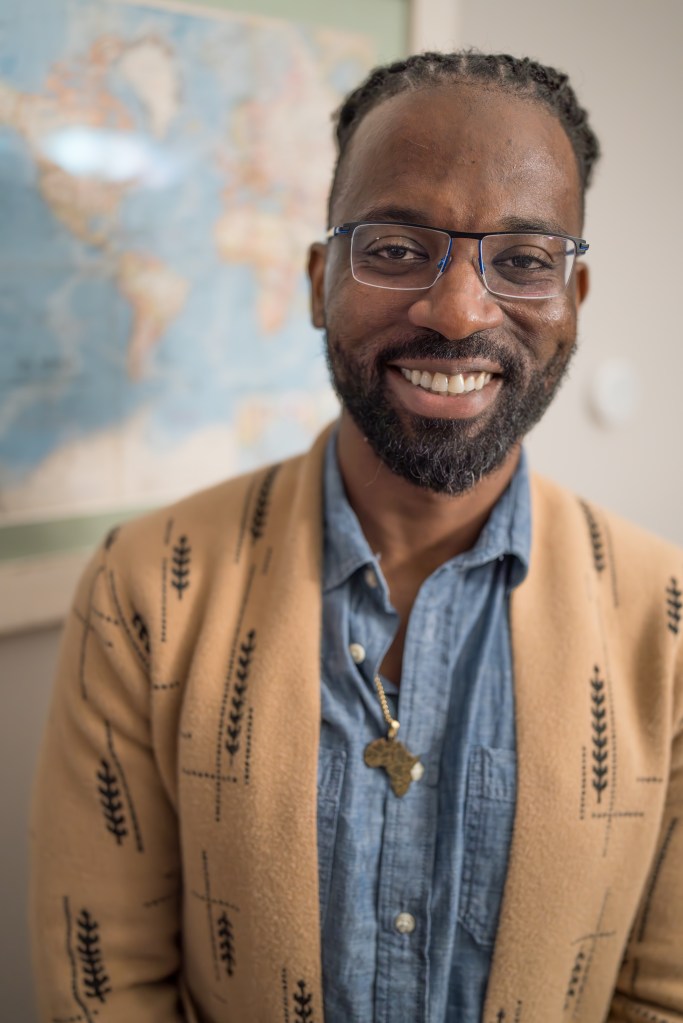
| Olu Ayo (he/him) is a Nigerian-American educator in Boston and an aspiring debut author. He comes from the Yoruba tradition of thinking, dreaming, and remembering through storytelling. He has worked out what his last meal on this Earth will be, Iyán and Egusi. His short story “SMOKE” was ranked in the top twenty-five percent of all stories submitted to the 2024 International Fiction Festival. His other short story “FALLING” will be published in February 2025 by Free Spirit Publishing in the short story collection TRAVEL STORIES. He is a Boston Writers of Color and Black Writers Collective member. Olu is on Instagram @olu_writesagain and Substack @writingunderthepalmtree. |
Instagram/X: @olu_writesagain
 wildscape. literary journal