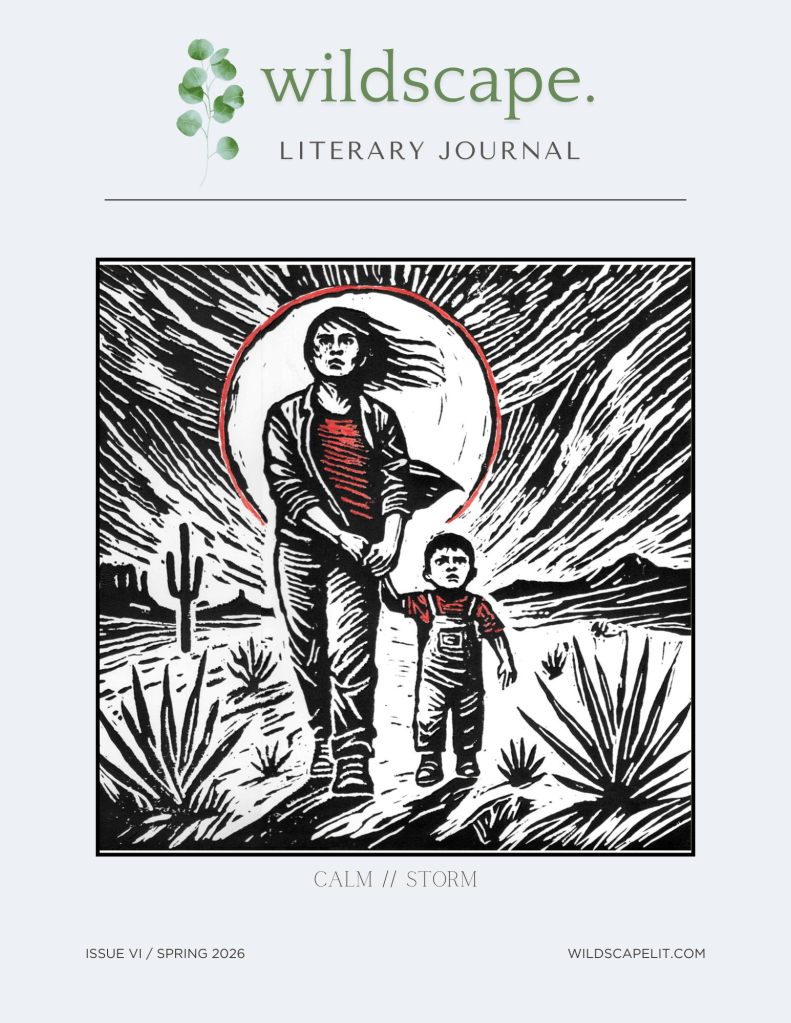
issue 6
// poetry
Veronica is our featured poet of Issue 6. Below are the links to all four of her poems in this issue, and beneath that, a series of questions and responses between Veronica and our Interview & Feature writer, Angela Heiser.
POEMS:
What Sleeps with Its Fist Uncurled
What The House Does Not Know Yet
We Did Not Inherit This Silence
Crosswalk Between Worlds
Interview with Veronica
Angela: Tell me about grieving your patients. The grief for someone else’s child that also reminds you of your own.
Veronica: There’s a particular kind of grief that comes from proximity without ownership. These are not my children, but I am there at the moment everything fractures. I know the weight of a body going still, the exact pitch of a parent’s voice when it breaks.
What makes it complicated is the overlay. I don’t just see the patient. I see the parallel. The same age, the same sneakers, the same imagined trajectory. It collapses distance in a way that feels both human and dangerous. You have to stay functional inside it.
The grief doesn’t always arrive when you expect. It’s not always in the room. Sometimes it’s later, in something small and ordinary. A crosswalk. A backpack. A question at breakfast. That’s when it lands, not as a single moment but as a kind of echo that keeps finding new surfaces.
Angela: These four pieces excel at portraying the juxtapositions of private and professional life that often encompasses the worst day of someone else’s life. What do those realities look like off the page?
Veronica: Off the page, it’s a lot less contained.
The transitions are abrupt. You leave a room where something irreversible has happened and then walk into a space where people are asking about dinner, homework, what time practice starts. Both realities are real. Neither cancels the other out.
There’s no clean boundary. The hospital comes home in fragments. Not in a dramatic way, but in these small shifts in attention. Watching your child cross a street a little more closely. Noticing how quiet the house is when everyone is asleep.
At the same time, home pulls you back into something grounding and immediate. It demands presence in a different way. The tension between those spaces doesn’t resolve. It just becomes something you learn to carry.
Angela: How do you navigate straddling those two vastly different worlds? And is there ever a need for recovery or re-centering when you pass from one to the other and show up in a different role?
Veronica: I don’t think it’s about fully separating them. It’s more about adjusting the volume.
At work, the focus narrows. You move through protocol, through rhythm, through what needs to be done next. There’s very little room for reflection in the moment.
At home, the opposite is true. There’s space for noticing, for being present in a slower way. But that shift doesn’t happen automatically. Sometimes it takes time to arrive.
Recovery isn’t always formal. It’s often quiet. A run early in the morning. Sitting with a cup of tea before anyone else is awake. Small routines that signal a different kind of attention.
It’s less about resetting completely and more about recalibrating enough to be where you are.
Angela: Tell us about the rhythm of this work (stanza three, “Crosswalk Between Worlds”) and how that translates to rhythm on the page. I especially appreciated how you were able to make the reader feel like they were in the hospital room without using medical jargon.
Veronica: The work itself has a rhythm that you internalize over time. There’s an order to it. A sequence of steps that becomes almost automatic, especially in high-acuity situations. That rhythm is what allows you to function under pressure.
On the page, I try to mirror that without naming it directly. The pacing of the lines, the way information is revealed, the movement between action and observation. Shorter lines can carry urgency. Longer lines can hold the weight of what’s being processed around the action.
I’m interested in how rhythm can place the reader inside the experience without relying on technical language. The goal is for the reader to feel the momentum, the pauses, the moments where everything narrows or expands, even if they’ve never been in that setting.
Angela: In “What Sleeps with Its Fist Uncurled”, you write “your pulse is a bird / I could cup in both hands.” Was there a specific patient or experience that inspired these lines? The lightness, smallness, and fragility really shine through for me here.
Veronica: That image comes from contrast.
In the hospital, pulse is something you measure, track, respond to. It’s data, it’s urgency, it’s something that can change quickly and require intervention.
At home, it becomes something entirely different. Quiet, steady, almost intangible. The metaphor of a bird felt like a way to hold both the lightness and the fragility of that moment without turning it into something clinical.
It wasn’t drawn from a single patient, but from the accumulation of experiences where pulse carries very different meanings depending on the setting.
Angela: To say that these poems fit our calm // storm theme to a T would be a phenomenal understatement.
Veronica: Thank you!
Angela: Your poem “Small Theologies” from Issue 3 (July 2025) earned you a nomination for Best New Poets 2026. I’d love to hear more about how you came to this poem, the vulnerability as a parent, the need to protect, the realization that we can’t.
Veronica: That poem started with a real question at the breakfast table.
Children ask things directly, without the layers we tend to add as adults. The question about why people make mistakes, even when they know better, felt both simple and impossible to answer.
The poem became a way of sitting inside that tension. Wanting to offer something meaningful, something that protects, while also knowing that there are limits to what can be explained or shielded.
The vulnerability comes from acknowledging that we don’t have control in the way we might want to. That even our explanations are partial. That we carry our own habits, beliefs, and contradictions into how we answer.
It’s a poem about trying to translate something complex into language a child can hold, while knowing that some things will remain unresolved.
Angela: What are your writing plans for 2026 and where can our readers support your work?
Veronica: In 2026, I’m continuing to work across a few ongoing projects that explore the intersections of medicine, motherhood, and memory.
My debut chapbook, The House as Witness, is available for preorder from Quillkeepers Press on Amazon, Barnes & Noble, and Walmart, and I’m focusing on sharing that work through readings and local events.
Readers can find more of my work and updates at http://www.veronicatuckerwrites.com, and on Instagram at @veronicatuckerwrites, where I share publications, events, and new writing.
Angela: On your website you mention how you write about “what’s real and raw” and that is as succinctly as I can sum up the effect your work has on me, especially as a parent. What is the significance for you of grappling with the real and raw in your work?
Veronica: In my work as a physician, I’m often present for moments that are unfiltered. There’s no narrative arc yet, no resolution, just the immediacy of what’s happening.
Writing becomes a way to engage with those moments without simplifying them. Not to explain or resolve, but to stay with the complexity.
The real and raw isn’t about intensity for its own sake. It’s about accuracy. About allowing space for contradiction, for discomfort, for things that don’t fit neatly into language.
It’s also about recognition. Creating something that resonates because it reflects something true, even if it’s difficult to name directly.
Angela: I need to know more about the gorgeous stained glass windows you feature on your website with the caption “A piece of Spain that still feels like a piece of me.”
Veronica: Those images are from the Sagrada Família in Barcelona.
I was there last year to run my first full marathon, and what stayed with me was the way the light moved through the space. It isn’t static. The colors shift depending on where you stand, what time of day it is, how long you’re willing to be still inside it.
It felt less like looking at something and more like being inside it.
Spain has been a meaningful place for me since I was younger, and returning there as an adult carried a different kind of awareness. The stained glass felt like a way of holding that continuity. Something intricate and luminous that changes, but doesn’t lose its structure.
Including it on my website is a way of keeping that experience close. A reminder of how light can pass through something solid and still transform it.
about the author // Veronica Tucker
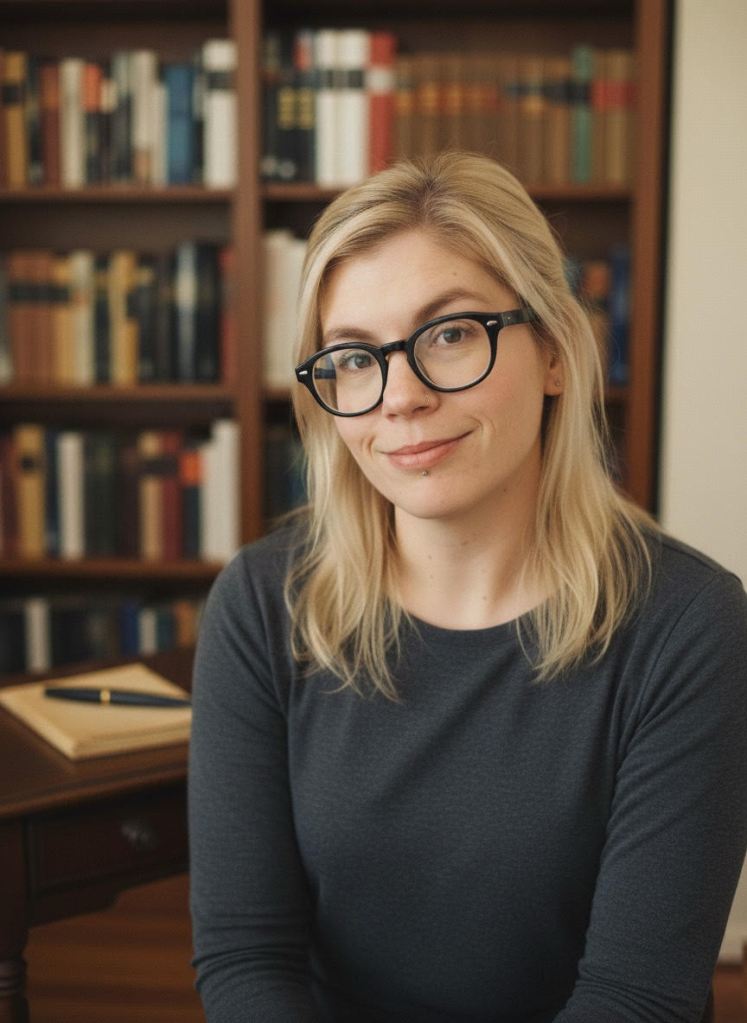
| Veronica Tucker is an emergency medicine and addiction medicine physician and writer living in the Lakes Region of New Hampshire. Her work explores the intersections of medicine, motherhood, and systemic injustice, drawing from years in both rural and inner-city emergency departments. She is a Pushcart Prize nominee with work in Rust & Moth, Eunoia Review, The Berlin Literary Review, and elsewhere. |
Instagram: @veronicatuckerwrites
Website
 wildscape. literary journal